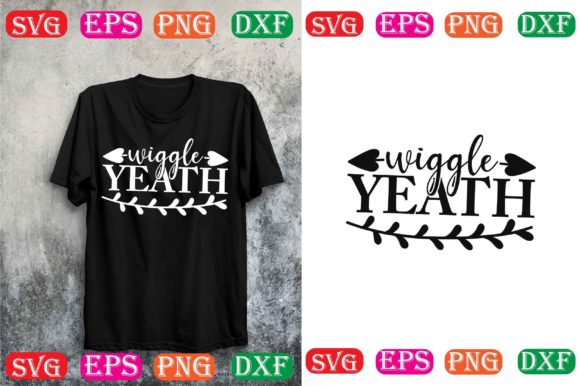
Dog Svg Design.wiggle Yeath
First Impressions: Playful, Not Precious
When Dog Svg Design.wiggle Yeath opened in my vector editor, I didn’t see a “cute dog”—I saw rhythm. The line work has bounce. The ears tilt just enough to suggest motion, not stiffness. The body leans forward like it’s mid-wag, and the tail curls with intention—not as an afterthought, but as part of the silhouette’s flow. It’s not hyper-realistic or overly detailed; it’s graphic, confident, and built for translation—whether into ink, thread, or heat transfer. As a machine embroidery design, its strength isn’t in complexity—it’s in clarity at scale.
Real Project Test: Embroidering a Linen Tote for a Local Bakery
Last week, I used Dog Svg Design.wiggle Yeath on a natural linen tote for a neighborhood sourdough bakery. They wanted something warm but not cutesy—friendly without being juvenile. We stitched it centered on the front panel, 4.2” wide, using matte cotton thread on medium-weight stabilizer. The result? Instant recognition. Customers smiled before they read the shop name. That’s the quiet power of this design: it reads fast, feels handmade, and holds up under daily use. No puckering. No lost detail in the ear curve or tail tip. It looked intentional—not like a stock graphic slapped on.
Where It Shines (and Where It Needs Care)
- Custom apparel: Works beautifully on crewneck sweatshirts and relaxed-fit tees—especially when placed on chest or sleeve. The clean lines avoid the “busy” look that overwhelms casual wear.
- Tote bag design & aprons: Holds presence on textured weaves. Linen, canvas, and midweight denim all let the shape breathe without fighting the stitch definition.
- Baby embroidery & nursery decor: Soft enough for onesies and pillow covers—but avoid ultra-fine knits unless you reduce size and add lightweight cutaway stabilizer.
- Holiday embroidery & personalized gifts: Pairs well with simple monograms or seasonal accents (a tiny bone, a paw-print border). Doesn’t compete—it complements.
- Embroidered patch: Clean edges mean crisp laser-cut or heat-seal backing. Just watch the inner curve near the jaw—it’s tight enough to need a light satin stitch adjustment if scaling below 2.5”.
Fabric & Fit Notes You’ll Actually Use
Dog Svg Design.wiggle Yeath behaves differently depending on what you’re stitching *on*, not just what you’re stitching *with*. On dark fabric? Go for high-contrast thread—navy + cream or charcoal + mustard keeps it legible without screaming. On stretchy fabric like jersey? Stabilize aggressively—this isn’t a design that forgives shifting. And on curved surfaces like caps? Skip the crown. It’s better suited to flat panels—front panels of dad hats, side panels of bucket hats, or the straight surface of a baseball cap visor.
Thin fabric? Reduce density slightly in fill areas—or switch to a lighter fill stitch pattern. Dense stitch areas (like the shoulder curve) can flatten on silk-blend tea towels unless you test first. And layered garments—think hoodies with pocket flaps or reversible jackets—need careful placement. This design doesn’t fade into background texture; it asserts itself. So if your base layer is busy, simplify the rest.
What It Does for Your Craft Business
As an Etsy seller or small shop owner, Dog Svg Design.wiggle Yeath isn’t just another digital embroidery file—it’s a consistency tool. It reads like part of a brand system, even when used solo. Customers recognize the tilt of the head across different products: a baby onesie, a kitchen towel, a holiday ornament. That builds trust. It says “I chose this—not grabbed it.” That perception lifts perceived value, especially for handmade product listings where professionalism matters more than polish.
For craft fair vendors or boutique owners, it’s shelf-ready. It doesn’t require explanation. No one squints at it. No one asks, “What kind of dog is that?” It’s friendly abstraction—not literalism—and that makes it versatile across age groups and aesthetics. A teen might love it on a backpack; a grandparent might gift it on a quilt square. That range is rare in T-Shirt Designs and Graphics meant for real-world use.
Practical Embroidery Designer Notes
- Always test Dog Svg Design.wiggle Yeath on scrap fabric *first*—especially if using textured or dark materials.
- Check thread color contrast in both natural and artificial light. What reads well on screen may disappear on oatmeal linen.
- Review stitch density: If your machine flags dense fills, consider splitting the design or simplifying interior curves manually.
- Confirm hoop size compatibility. This design scales cleanly—but pushing below 2” risks losing the expressive tilt in the ears.
- Inspect small details: the space between ear and head, the tail curl endpoint, and the eye shape. These define personality—and vanish if digitized poorly.
- Test black-and-white mockups. If it works in monochrome, it’ll work anywhere.
- Compare performance on light vs. dark fabric backgrounds—not just for visibility, but for how stabilizer shows through.
- Use proper stabilizer: tear-away for stable wovens, cutaway for knits, and mesh for sheer layers.
- Verify licensing before selling finished items or bundling Dog Svg Design.wiggle Yeath with other design assets.
Final Thought: It’s Not Just a Dog—It’s a Moment
Dog Svg Design.wiggle Yeath doesn’t try to be everything. It’s not a photorealistic portrait. It’s not a cartoon mascot. It’s a gesture—confident, approachable, quietly alive. That’s why it lands so well on a sweatshirt for a dog-walking service, a tea towel for a pet-friendly café, or a baby blanket for a new parent who wants joy without clutter. In a market flooded with overdesigned graphics, this one breathes. And in embroidery—where every stitch carries weight—that’s the highest compliment.